The final map is set, and the countdown begins. The second tranche of Opportunity Zones is nearly here. In 2025, the "One Big Beautiful Bill" (OBBB) made the Opportunity Zone incentive permanent (OZ 2.0). On Nov. 5, 2026, Treasury and the IRS announced the new Qualified Opportunity Zone designations for all 50 states. On Nov. 13, the IRS followed with Notice 2026-67, which formally lists the designated census tracts. All 6,576 tracts nominated by the governors were designated and 2,594 of them (about 39%) are rural. The new zones take effect Jan. 1, 2027, and remain in place through Dec. 31, 2036. For the first time since the incentive launched in 2017, investors, fund sponsors and developers know exactly where the next decade of Opportunity Zone investment can go.
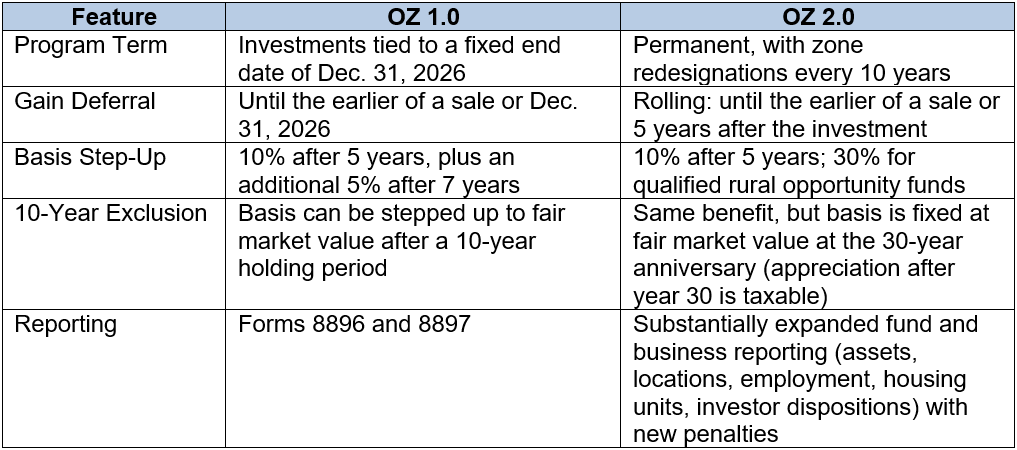
As background, the 2017 Tax Cuts and Jobs Act (TCJA) created the initial Opportunity Zone incentive (OZ 1.0). OZ 1.0 allows taxpayers to defer tax on capital gains for five years by investing those gains in qualified opportunity funds (QOFs), which in turn invest in businesses and property in targeted low-income census tracts. If investors hold the QOF investment for 10 years, the realization on such QOF investment can be excluded from income. The OBBB did not extend the OZ 1.0 program. Instead, it layers a permanent OZ 2.0 framework on top of it, with zones reselected every 10 years; a rolling five-year deferral period for investments made on or after Jan. 1, 2027; enhanced benefits for rural areas; and significant new reporting requirements.
How OZ 2.0 Differs from OZ 1.0
The final map is set (and linked below) and, with less than seven weeks until OZ 2.0 opens, the countdown begins.
You can review a map of all the zones here: https://www.policymap.com/embed/widget/12163/DNAOEK4MOFUIAGJCCEX7MVRX9IRWBIKG
Here are five key considerations.
1. Check the New Map Against Your Pipeline
Tighter income thresholds and the end of the contiguous-tract rule mean some OZ 1.0 tracts did not make the cut, and some new, more economically distressed tracts have been added. Because the final map is set, sponsors should confirm now whether current and planned projects fall within an OZ 2.0 tract. OZ 1.0 tracts remain designated through Dec. 31, 2028. However, property acquired after Jan. 1, 2027, in an OZ 1.0 tract that was not redesignated qualifies only under limited transition exceptions.
2. Dec. 31, 2026, Is Still the Deadline to Pay
The OBBB did not extend the original deferral date. Any gain still deferred under an OZ 1.0 investment must be recognized on Dec. 31, 2026, and that gain cannot be rolled into OZ 2.0 for a new deferral. As the countdown begins, existing investors should ensure they have enough liquidity to pay the tax due with their 2026 returns.
3. Time Your Gains to the 180-Day Clock
The 180-day investment window remains a critical feature of the program. Under Treasury's transition guidance (Notice 2026-40), a gain realized in 2026 can be invested in OZ 2.0 during whatever part of its 180-day window falls in 2027. The pass-through rules give investors extra runway. Partners and shareholders may be able to start the 180-day clock for gain realized by a pass-through entity as late as the entity's unextended return due date. For a project in a tract that was renominated, it may also pay to wait until Jan. 1, 2027, to invest so the investment qualifies for OZ 2.0 benefits.
4. Look Hard at Rural Opportunities
The OBBB tilts the incentive toward rural areas. Qualified rural opportunity funds receive a 30% basis step-up after five years, three times the standard 10%, and need to meet only half the usual "substantial improvement" threshold. Nationwide, roughly two in five of the new zones are rural. These enhancements could make projects viable that would not have worked under OZ 1.0.
5. Build Your Reporting Infrastructure Now
The new reporting regime will change compliance for both new and existing funds. QOFs and the businesses they invest in will need to track and report information such as asset values, census tract locations, residential units, employee counts and investor dispositions, and the penalties for reporting failures are significant. Treasury and the IRS have already proposed reporting regulations, and more guidance is expected. Under OZ 1.0, the IRS issued a significant number of private letter rulings to rescue funds that made simple filing errors. The countdown begins for compliance, too. Funds should put data-collection procedures in place now rather than reconstruct the information at filing time and should make sure their tax and legal advisors know the program well.
The final map is set and the countdown begins. If you have questions about how OZ 2.0 affects your existing investments or planned projects, please contact Ross Keogh at rkeogh@parsonsbehle.com.