The Second Regular Session of the 68th Idaho Legislature, which adjourned sine die on April 2, 2026, saw less action in alcoholic beverage licensing than the tide-turning legislative sessions of 2023 and 2024, but some changes are notable.
Substantive Changes to Law
The following alcoholic beverage licensing bills were successfully passed and signed into law, with effective dates of July 1, 2026.
Brewery retail locations (S1301): Sponsored by Sen. Treg A. Bernt, this bill amends I.C. § 23-1003 to allow a brewery to have up to two remote retail locations (increased from one) and one retail location at the main production brewery, for a total of three retail locations.
Liquor licenses held by distilleries (S1258): Sponsored by Sen. Brandon Shippy and championed by lobbyist Roger Batt, this bill makes a handful of statutory amendments (including to I.C. §§ 23-903, 23-910, 23-912, and 23-944) to explicitly authorize distilleries to sell liquor by the drink for brands they own, without having a co-requirement to serve food.
ABC Rule Changes: Following notice given under Idaho Code § 67-5220(1) and (2) in the Administrative Bulletin last fall and the subsequent administrative procedure, the Idaho State Police Department of Alcohol Beverage Control (ABC) rules will change as posted on the ABC website at https://isp.idaho.gov/wp-content/uploads/ABC/Letters/2025-Proposed-Rulemaking-Procedures.pdf. The most impactful rule changes include:
- Refinement of the “actual use” requirement for a license. Going forward, licensees must use their licenses by selling and serving alcohol not less than three days and 24 hours per week (the prior rule being simply a requirement for “weekly” use).
- Restrictions on the restaurant endorsement for each licensee tightening up, so that all liquor sales must end when food sales end, and no restaurant promoting itself as a “bar or lounge.”
- Revisions made to the requirements for a licensee holding the multipurpose arena facility endorsement.
Substantive Changes Rejected
Catering licenses (S1231): A bill to authorize "established caterers" to obtain liquor licenses for catering events died in Senate State Affairs. At present, the method for a caterer to obtain a liquor license for use at an event is less than clear, because catering licenses are issued by each city or county, and are effective for different periods of time; thus, the licensure processes vary across the state. A letter issued by the ABC Captain (ABC) in 2023 (located here: https://isp.idaho.gov/wp-content/uploads/ABC/Letters/2023-City-County-Clerks-Issuing-Catering-Permits.pdf) provides some clarifications to the process, but we still have an uneven patchwork of city and county regulation. In addition, winery catering rules differ, as do nonprofit licenses for events, furthering the confusion in regulating and licensing temporary events. We expect to see further legislation in this area in the future.
Money Trouble
Several bills were introduced that attempted to fix the budgetary shortfalls at ABC. Those budgetary problems were caused by the 2023 elimination of generally unfettered transferability of liquor licenses, since ABC charges an administrative fee on each transfer. Many of the bills cited a 47% decline in income felt by ABC because of the corresponding drop in transfers.
- Two such bills died in Senate State Affairs (S1230 and S1268) and one (H0944) died in the House.
- However, a house bill (H0793) passed into law which redirects 33% of the tax collected on beer (defined as having an alcohol content of 5% or less) to the Idaho State Police. Out of this redirected amount, 40% is specifically dedicated to the ABC unit.
- On the theme of budgets, H0924 was passed which provides funding enhancements to the State Liquor Division’s (ISLD) FY2027 maintenance budget to cover store operational costs, while H0867 made standard adjustments for ISLD personnel benefit costs, contract inflation, statewide cost allocation and a base reduction.
Cut It Out
As part of the overall push to cut back on Idaho statutes, the legislature also passed specific repeals of outmoded Idaho law on alcoholic beverages, including H0799 (removing obsolete provisions regarding the prohibition and sale of liquors and wines) and H0690 (repealing a law requiring the Idaho AG’s office to participate in a sobriety and drug monitoring program).
Otherwise Deadlocked
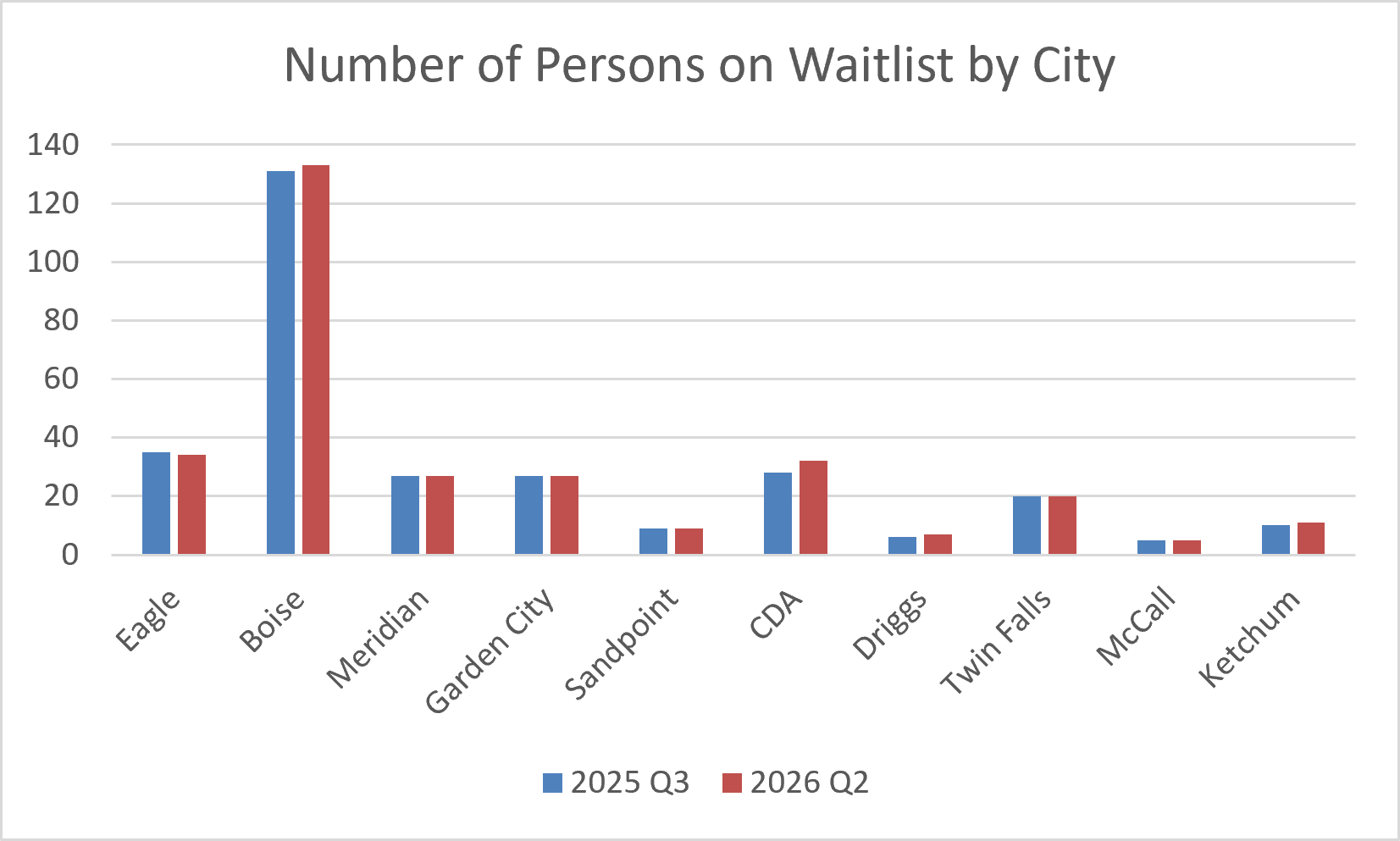
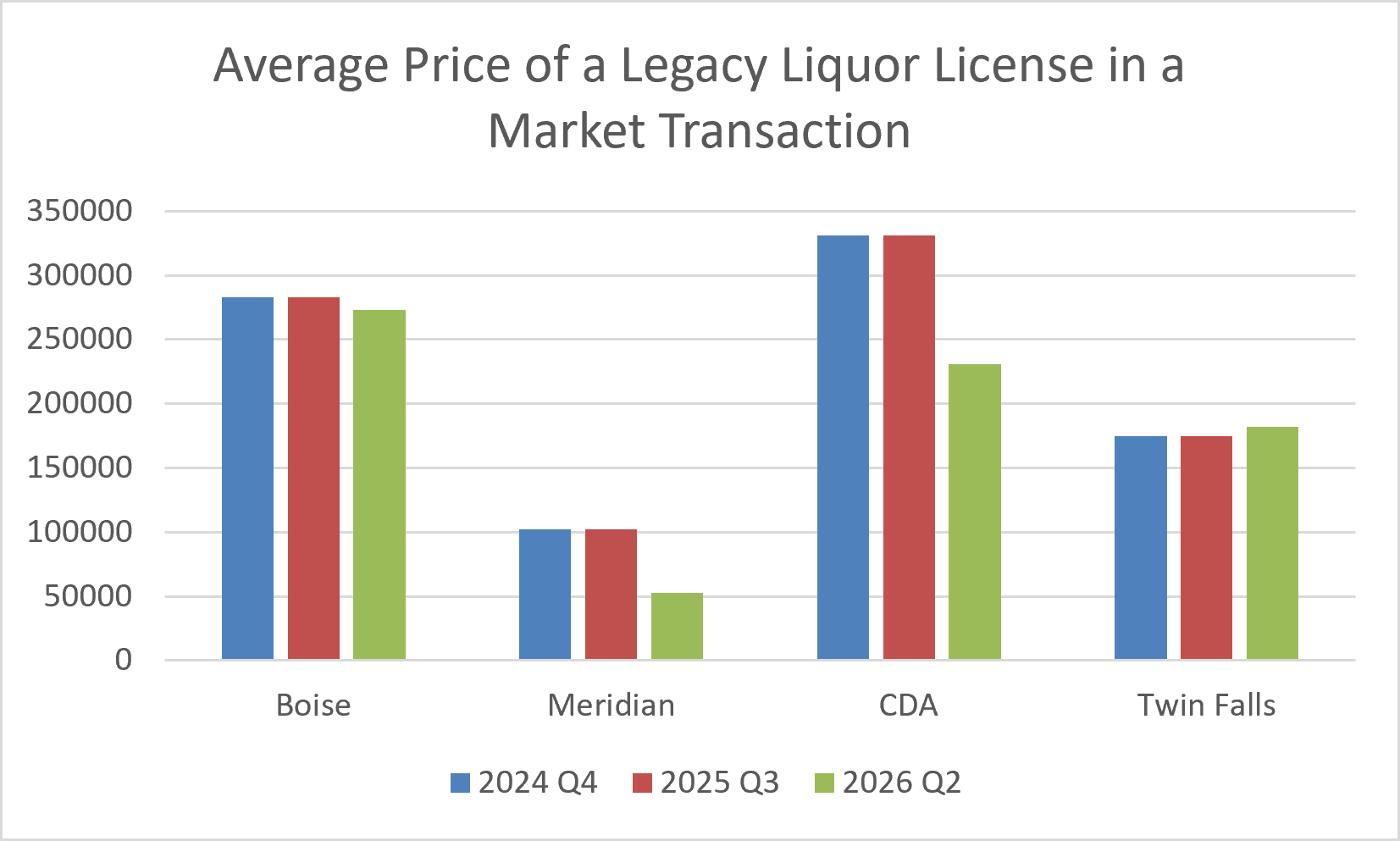
This office pulls data from ABC via public records request on a regular basis. In reviewing that data, it appears that the liquor license issuing system has deadlocked since the sweeping legislative changes of 2023. Applicants appear to be waiting in line for the same period for a new off-the-shelf quota license and paying about the same price for a use license. For example, following is a comparison of the ABC license waitlists over the past year in 10 key Idaho cities:
Additionally, the average price of a liquor license remains relatively flat in two of four major Idaho cities for a similar period:
This makes us wonder what the Idaho legislature may do next with respect to licensing liquor sales, and how the market will react (and it will).